
Connect Two (Or More) Accounts with Microsoft Teams Connect
This year at Microsoft Ignite, Microsoft announced Microsoft Teams Connect. Teams Connect eases collaboration with people inside and outside of your organization by enabling shared channel-like functionality.
- Arguably one of the greatest features of Slack is its ability to integrate with such a vast array of tools. You can even use it along with Webex Teams and Cisco Webex Meetings. Ideally, you want to incorporate a tool into your infrastructure that can integrate with your existing system.
- The Webex call app allows you to use your enterprise voice and video calling platform directly from Slack. The app integrates Slack with your Webex app desktop client making calling simple. The native calling buttons in Slack are mapped to your Cisco calling solution allowing you to call from Slack direct messaging and contacts view.
To best understand what Teams Connect is and how you can benefit from it, it’s important you first understand the inner workings of Microsoft Teams.
Some background on Microsoft Teams
Microsoft Teams is an extendable platform for collaboration on Microsoft 365.
Microsoft Teams: How to use it, and how it stacks up to Slack and Zoom. Microsoft Teams, and Cisco Webex were the big winners of the global shift to remote working during 2020, there has also.
Instead of segmented information and workplace silos, it provides content in the right context through the use of channel-based working.
Within each team in Microsoft Teams, users get a set extra services aside from appears on the front end:
- SharePoint site including a document library to work on files.
- OneNote notebook for unstructured notes.
- Exchange Online mailbox with a shared calendar to plan meetings and calls.
- Planner plan to manage tasks within your team.
- Power BI workspace (you will need an extra license).
- Stream video channel.
Access to a team is secured by an object in Azure Active Directory called Microsoft 365 Group.
This group has a list of members and defines who can access the team:
Microsoft Teams uses a straightforward approach for roles:
- Owners create a team, invite and remove members and guests, and can delete a team.
- Members can create channels (standard and private) and create tabs.
- Guests can only work in their given structure.
It’s external users and guests who will benefit the most from the introduction of Teams Connect.
External users in active directory
As an owner of a Microsoft Teams team, you can invite members (internal) and guests (external).
Internal users are already present in your own tenant’s Azure Active Directory. Guests get added to your Azure Active Directory as external users, indicated by the `#EXT#`-suffix:
Usernames of external users look like this:
{UserName}_{theirTenant}#EXT#@{yourTenant}.
As you can see, the source of authority is the External Azure Active Directory.
Channels
There is a connection between channels and the document library in SharePoint.
For every standard channel you create, a folder is created in that document library. Files shared in a channel show up in the folder inside of the document library that reflects the channel.
User experience for external users
Sharing information securely across organizational boundaries is in high demand.
Collaboration with guests takes place in the tenant they get invited to. Edius 8 serial number key. This means that they need to switch to that tenant to see new messages.
This also means that they are not logged into their own home tenant.
This is a major showstopper for collaboration as guests don’t get the full user experience like members.
Members feel that guests are still disconnected from the team.
Their user experiences are not comparable.
This leads to cumbersome workarounds like @-mentioning the channel to enforce a notification.
In some cases, people start using email again to state that a conversation takes place in Teams. In the end, those workarounds will create a less satisfactory user experience.
Workarounds
As a guest, you can use this practice:
- Create different profiles in the browser of your choice and then even install this website as an app.
- Install the website as an app in Microsoft Edge
The web version of Teams doesn’t give you full functionality and collaboration isn’t as seamless as it can be. The Teams web client doesn’t support virtual backgrounds among other features.
Mentally, switching context can be exhausting and a real kicker for productivity. It also forces us to have more windows open which is a distracting factor for many of us.
Teams Connect
To solve this, Microsoft introduced Microsoft Teams Connect.
Teams Connect is using so-called shared channels. Shared channels appear in our home tenant like any other standard channel.
How to create a shared channel
Creating a shared channel is easy.
By clicking on the ellipsis icon next to the name of the Team you want this channel to live in, select Add a channel.

Now add a name, and under Privacy, select shared channel.
Add people inside or outside of your organization. You can start collaborating now.
This will improve user experience as users don’t need to switch tenants anymore.
They can stay inside the context they usually work in.
Shared channels appear in their usual work environment making collaboration easy and seamless.
What is the difference between a shared channel and a private channel?
Microsoft introduced private channels at Ignite 2019. In private channels, only a subset of the owners, members, and guests of a team can access information.
If someone is not already in the team, you can not add them to a private channel.
A private channel is like a safe inside of a room.
You need to be already in the room and have the key to that safe to be able to open it.
Files shared in private channels will not show up in the team’s SharePoint site. Files are saved in a different SharePoint site that doesn’t belong to the Microsoft 365 group.
External members of a shared channel are not guests of the team. Their display names in Teams don’t get a (Guest) suffix, but an (External) suffix.
Shared channels get a special icon. This way, everyone is aware that these channels are shared with different people.
How will this change the way we work in Teams?
Adding shared channels to a team ensures that we can keep the existing structure.
We can expand our internal collaboration experience to our external partners.
This also eases our teams’ architecture.
We will create less teams and less private channels.
People will spend less time being torn between channels and tenants, and collaboration becomes collaboration again (rather than administration).
How to get Teams Connect
Currently, this feature is in private preview and will roll out later in 2021.
Microsoft invites certain Microsoft tenants and users to partake in private previews. As such, there is no waitlist to join.
Conclusion
Teams Connect and shared channels will be a game changer for businesses who frequently collaborate with users outside of their own organization.
Before Teams Connect, people needed to find different workarounds. They restructured teams, rolled back on email, or tried to collaborate in chats.
With shared channels, people can stay in the flow of their work.
If you’re reading this and wondering if there’s a way to extend Teams Connect or shared channel functionality to other platforms, you’re in luck.
Read this post on how to connect Teams to other platforms.
Slack vs Microsoft Teams vs Webex
The most popular team communication tools are Slack, Microsoft Teams, and Webex.
You can see those stats by clicking the Workplace Messaging Report below.
When you are searching for collaboration and communication applications, you will come across these three time and time again.
Each solution brings different functionality and features to the table so making a selection is often challenging.
You’ll often be thinking…
- What should I know about these applications?
- Which features are truly enterprise-grade?
- How can I choose between them?
Often, IT Managers and CIOs are required to have all the information about platforms available before making a decision about which to choose.
That’s why this post breaks down the main considerations for choosing between Slack, Microsoft Teams, and Webex. We then discuss what to do if you still can’t pick between each one.
If you already know enough about these platforms, you can SKIP AHEAD to the Slack vs Microsoft Teams vs Webexsection.
SPOILER ALERT: You don’t have to pick just one platform!
1 – What is Slack?
At its core, Slack is considered an IM app, but one with a host of additional plugins.
It has been created with the purpose of bringing together in one place all the moving parts of a businesses communication.
The variety of features it has available doesn’t disappoint and that’s why so many companies are using it as their primary collaboration tool.
This online-chat space has gained recognition in the business world thanks to its range of functionality that tackle communication barriers within an enterprise.
You can keep all communication styles together in one app, Slack replacing instant messaging, text messaging, and email.
“Effective communication is critical for teamwork success. Being able to maintain collaborations productively can be challenging within a large company, especially if employees have different schedules or work in different departments. Advanced messaging tools can bring impressive improvements here.”
Andrew Baxley, Team Manager at Studicus writing service.Slack Features
The main features of Slack are:
- Sharing files
- Group chat or direct messaging
- Access 100+ integrations
- Using the open API to build your own integration
- Access to securely encrypted transfer data
- Mobile and desktop messaging
- Advanced search functionality
- Two-way audio and video
- User profile personalization capabilities
You can choose Slack for free, or the Standard or Plus Slack plan, depending on your needs and to what extent you want the application’s functionalities to go.
If you are part of a larger organization, you can also opt for Slack Enterprise Grid, designed to foster communication in larger departments and companies.
Here are the most important differences between each Slack plan:
Slack Free
- Messaging
- Calls
- Search
- Storage
- Perfect for early startups and very small teams
Slack Standard
- Pricing: 6.67 USD per person per month (when billed yearly)
- Includes unlimited apps
- Group calls and screen sharing
- Allows guest accounts
- 10GB of storage for each user
Slack Plus
- Pricing: 12.5 USD per person per month (when billed yearly)
- 99.99% guaranteed uptime
- Allows export of all messages
- Single sign-on (SSO)
Slack Enterprise Grid
- Price to be discussed with the sales team, depending on your needs
- Unlimited workspaces
- Prevention of data loss
- HIPAA-compliant collaboration
- Perfect for large corporations in highly regulated industries
Slack Channels
Staad pro v8i tutorial for beginners. You can use the tool for one-on-one, private or group communication, as well as fire sharing.
A group conversation takes the shape of a multi-party direct message or as a Channel.
Within a channel, members have access to all the content, history, and files previously shared in this persistent chat environment.
You can easily create a new channel, join or leave the group conversation, the overall communication experience being similar to social-media.
Channels can be made private so only defined users have access to each channel.
Channels can also be created across different companies, creating a collaborative working environment for teams in different businesses.
A good example here is when contractors are assigned to work with a specific business for an extended period of time – or when a supplier/buyer relationship needs an open and continuous method of communication.
Slack Search Functionality
Search functionality can make an enterprise’s operations faster and more effective, so an app that focuses on this specific feature will always be a great choice.
Slack updated its search module recently, and the feature is now reported as more intuitive, intelligent, and useful.
Just by typing out a key phrase or keyword, you get results from the repository of data, conversations, and files.
Slack Integrations
Many third-party service integrations, like Google Drive, Trello, Asana or Zendesk, are available in Slack.
Integration is easy and it permits you to add the elements that will make team collaboration more effective.
Speed of support, robust notifications, easy file uploading and archiving are just a few other examples of what Slack has to offer.
2 – What is Microsoft Teams?
Microsoft Teams, commonly adopted as simply “Teams” is an equally popular communication and collaboration solution.
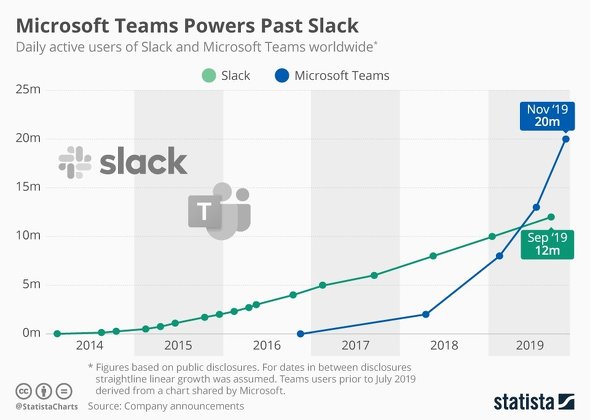
In fact, Microsoft has recently confirmed it has 115m daily active users.
Teams is often implemented by enterprises with multiple teams across many locations, and has some powerful features available, targeting on-going in-house communication efficiency.
Microsoft Teams Features
This app’s main functionality starts with a team (unsurprisingly!)
You can create a group and invite the team members you want to collaborate with.
For collaborations with freelancers or people from different departments, you can invite guest users as well – for temporary communication.
Within a team, you can collaborate on common tasks, communicate via messaging, calls and video calls and share files.
Microsoft Teams Channels
Just like Slack’s channels, these are conversations with different members of your team.
You have the option to create a channel for a project, a department or a topic, depending on the specifics of your business’ needs.
Through a channel, you can hold audio and video meetings, send files, collaborate on documents in real-time, or simply chat.
Microsoft describes the differences between Teams and Channels here.
Microsoft Teams Tabs
The Tabs component allows you to navigate through the entire content of your channel.
Three tabs come incorporated by default: Files, Conversations, and Wiki.
The Files tab is where you can find all documents and information shared by your team:
On the other hand, in the Conversations tab, you will find all your messaging history from the members of your teams:
We’ve laid out the best Microsoft Teams features that we use in this post below.
Pros of using Microsoft Teams include:
- Up-to-date and budget-friendly
- Secure
- 150 connectors to Microsoft and third-party services
- Mobile device management with Microsoft Intune
- Easy meeting scheduling
- Integrated with Microsoft Office 365
- Slash command shortcuts
Besides group-file sharing and messaging between users, some businesses rely on Microsoft Teams for content creation as well, combining this collaboration app with writing tools and services, like TrustMy Paper, Grammarly, GrabMyEssay, Google Docs, or BestEssay.
You can read an overview of the best Microsoft Teams integrations in the post below.
Enterprises usually favor Teams as an all-round communication tool thanks to its meeting and calling functionality.
Microsoft Teams comes in three different plans: Free, Office 365 Business Essentials (5 USD per user per month) and Office 365 Business Premium (12.5 USD per user per month).
3 – What is Cisco Webex?
A state-of-the-art collaboration solution, Cisco Webex has its own important role among the variety of communication tools on the market.
It ensures efficient teamwork, regardless of where the members of your team might each be. You may be familiar with traditional Webex productivity tools but the collaboration app is fairly new to market.
Webex combines messaging, file sharing, calling, meetings, and integrations.
The tool’s most important collaboration functions are:
- Chat – this is a must for any application of this sort. Webex permits you to stay connected to your team members constantly with a persistent chat feature, group messaging, and customizable notifications.
- Whiteboard – real-time writing, drawing, and document editing with digital and virtual whiteboards.
- Meetings – host online meetings with your team and access collaboration features, like whiteboarding or screen sharing.
- Scheduling – organize and manage your schedule for upcoming meetings. You can integrate this function with the current calendar tools you are using.
- File sharing – save and send files easily. Files remain where you’ve initially saved them, making searching for a specific document easy.
- Calling – you can make voice calls from within the application, the tool being fully compatible with Cisco Webex Calling and Cisco Unified Communication Manager.
These functions have been added to ensure seamless continuity from physical to virtual spaces and from one device to another.
The interface of the application maintains a simple design, keeping all capabilities easy to understand and use.
Cisco Webex Features
Key Webex features that draw interest to Webex are:
- End-to-end data encryption
- Integration with state-of-the-art software like Salesforce, GoogleDrive, Dropbox, and many more
- Access to artificial intelligence and bots
- Device security capabilities
- Intelligent file searching
- Integration with business-critical tools
Webex is available in three different packages for different businesses, having a flexible payment plan available as well.
Slack vs Microsoft Teams vs Webex
The ultimate question.
Which one is the best?
There is no right answer.
Each tool has its specific purpose, and while some features intertwine, others remain representative of that particular application and offer a better fit for different business types.
Historically, engineers have favored Slack, teams with Cisco VoIP devices used Webex, and Office 365 always have Teams included in their package.
Making a comparison is necessary to understand how one app is different from the other, and why each might be indispensable to your business.
What to look for when comparing Slack vs Microsoft Teams vs Webex
Pricing
Freemium versions are available for all three applications.
Upgrading is advised if you want to have access to advanced functionalities like unlimited workspaces, more storage, screen sharing group calls, guaranteed uptime, HIPAA compliance and more.
Webex has an easy-to-understand pricing method, which can be scalable.
Slack and Microsoft Teams come with similar costs for upgraded versions.
Onboarding
Getting started with these applications is something you probably want to look into in advance.
Onboarding should be simple and fast, influencing the productivity and efficiency of your operations.
Setting up Microsoft Teams might require a migration from Skype for Business or the setting up of a SharePoint directory.
Slack has faster deployment in 7 or 8 steps, requiring no phone number entry or credit card registrations.
To get started with Webex, you can start the trial process for free by entering your business email and downloading the app, and continue upgrading your plan from there.
Layout and Design
In terms of design, Slack has the most customization options available.
All three tools, however, maintain an easy-to-understand layout, focusing on capabilities rather than complex visual features.
You have vertical panels, a search box, and the usual tabs for Chat, Channels, Files, Teams, etc.
This element is very much personal choice so make sure your teams have a say in what will work best for them.
User Invites
For Slack, you can either ask members to join the workspace, or simply invite users after you’ve created the said workspace.
With Microsoft, the system demands you to first invite users to the Office 365 Admin Panel, found in the Office start page.
Webex allows you to add users manually in the Cisco Webex Control Hub. Members will appear in an invite pending stage until they sign in for the first time.
Messaging
Direct chat and threaded conversations are accessible on all three of these applications.
The tools each support group chat and each has incorporated standard messaging features like deleting, editing, pinning, and @ mentioning.
Powerful notification systems are also guaranteed regardless of application.
Recently, all three communication platforms introduced the possibility to react to messages, as well as add additional reminders.
File Sharing
With Slack, the maximum file size you can send is 1 GB.
With Microsoft Teams, you can go up to 15 GB.
Webex restricts files to less than 2 GB.
Integrations
Each application has capabilities in terms of tool integration.
Slack probably has the winning position, with the highest number of integrations.
However, you need to make sure the integrations available are the ones your business uses.
Mio has highlighted the best integrations per platform in these posts:
Slack Integrations | Teams Integrations | Webex Integrations
Managing Multiple Communications Tools
Ultimately, you don’t need to choose a single tool.
You will have different personalities in your business.
Each person will have different experiences from other businesses they have worked in and from software they use in their personal lives.
Personal preference will always trump dictatorship in business collaboration.
Ignoring this almost always leads to workplace silos, where one department uses one tool and the other uses something else.
If that doesn’t happen, and in most cases, as well this happening, we see shadow IT rife across businesses.
Shadow IT is what happens when individuals introduce their own choice of software, hardware, or alternative to the business norm and it takes over as the office go-to tool.
Conclusion
Now that you know a bit more about each one of these collaboration tools, you still might be tempted to choose a single option.
And that’s fine.
Each tool has its own standout area.
You probably already know which is your personal favorite right now.
However, that same thinking applies to each member of your business. At a higher level, it definitely applies to each department thinking one tool will be better suited for their niche needs.
Before you commit to a single platform, you must consider interoperability.
Using multiple chats simultaneously is possible, as long as you access the right solution.
Slack users can stay in Slack.
Teams users can stay in Teams.
Mio is the behind the scenes tool that syncs everything together.
Webex Teams Microsoft Teams Slack
When you implement your team collaboration platform, start with Mio from day one.
Webex Teams Vs Slack
With Mio in the background, you can let users leverage the benefits of the platform of their choosing while remaining able to chat with their colleagues on another platform.
Mio has a full synchronization feature which works in the background of your existing messaging platforms, and provides seamless chat interoperability across channels, DMs, and even group DMs.
See it in action here:
If some of your employees prefer Webex, while others work better with Slack, no one has to compromise.
Departments can collaborate without inconveniences, users can use the app of their choice, and no further training is required because no one will have to make a switch.
Posting, sharing a file, direct messaging to a Webex user via Microsoft Teams or Slack is made possible.
The user on the other end will not experience any differences and likely won’t even realize their colleague is using a different chat app.
Key Features of Mio
Webex Teams Vs Slack
- Synchronization of spaces and channels across all chat applications
- Find and message users across multiple tools
- Synchronization of all chat application features, like message editing, mentions, file uploads or video calling
- Safe and secure integration
- One company, a single conversion
Final Thoughts
Webex Teams Vs Slack
Maintain collaboration in your enterprise by accessing the functionalities of the most popular messaging application on the market.
Let your team members decide which tool to use, and cover the functionalities of Microsoft Teams, Webex, and Slack easily with the help of Mio.
You must be logged in to post a comment.