
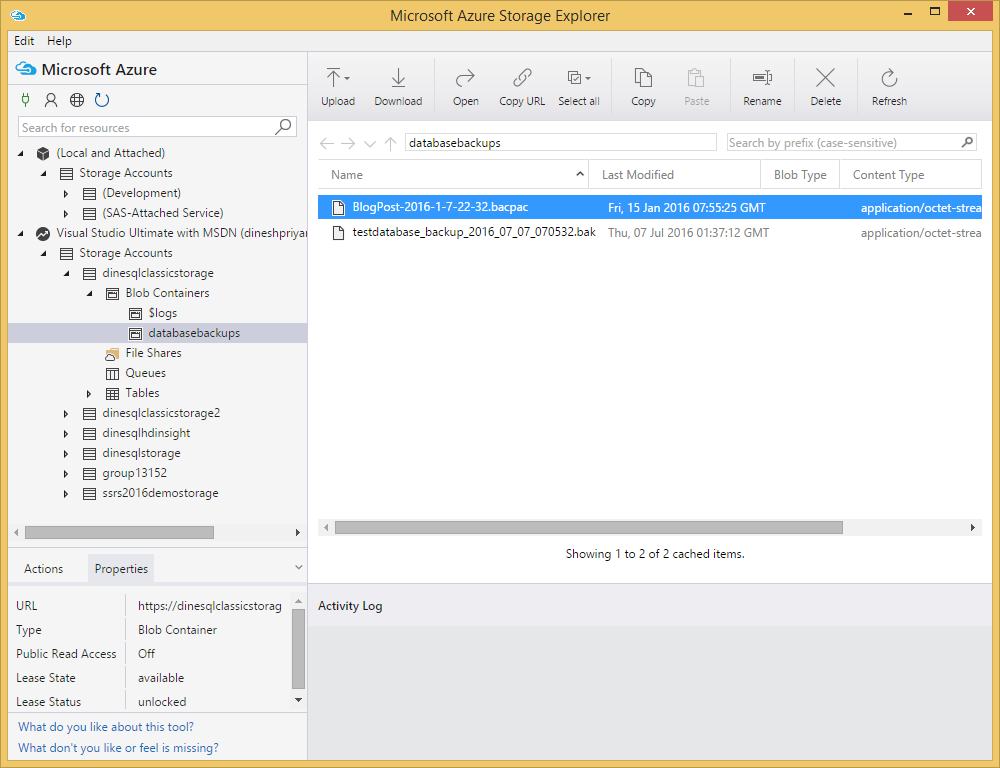
Storage Explorer 1.10.0 enables users to upload, download, and copy managed disks, as well as create snapshots. Because of these additional capabilities, you can use Storage Explorer to migrate data from on-premises to Azure, and migrate data across Azure regions.
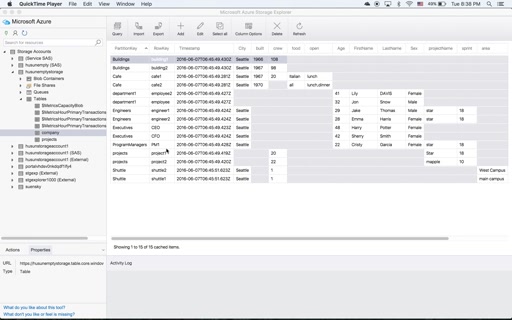
The Azure Data Factory (ADF) team has created an extension for Storage Explorer. This extension allows you to leverage ADF's ability to perform high throughput, server-side transfers from Amazon S3, Azure Blob Storage, or Azure Data Lake Gen2 Storage to Azure Blob Storage or Azure Data Lake Gen2 Storage. Microsoft Azure Storage Explorer - how to query column containing JSON string. Ask Question Asked 10 months ago. Active 10 months ago. Viewed 251 times 0. I am trying to perform a filtering using the query as shown in the image below, expecting it to filter specific matching rows.
Prerequisites
Ms Azure Storage Explorer Tool
To complete this article, you'll need the following:

- An Azure subscription
- One or more Azure managed disks
- The latest version of Azure Storage Explorer
Connect to an Azure subscription
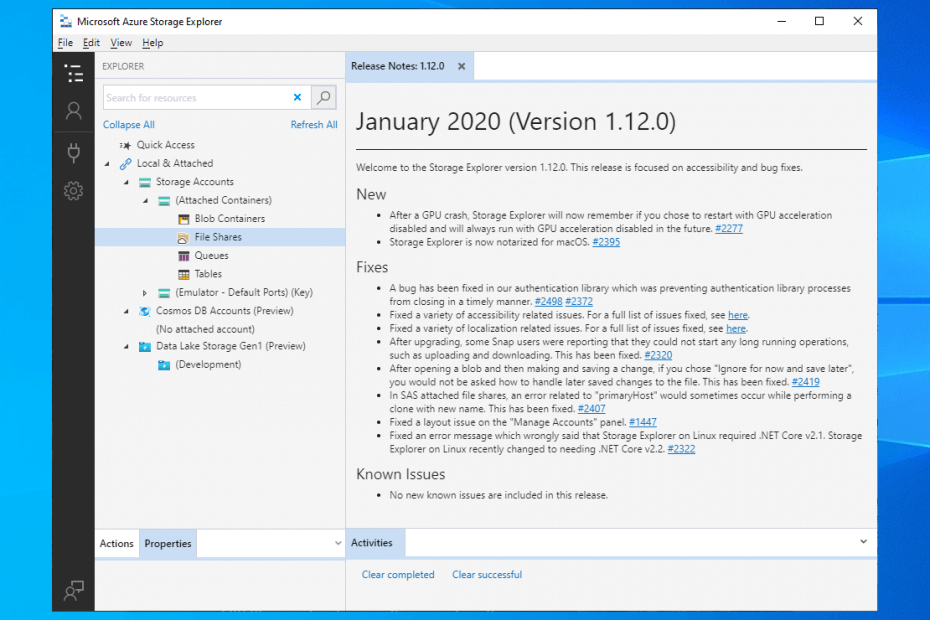
If your Storage Explorer isn't connected to Azure, you will not be able to use it to manage resources. This section goes over connecting it to your Azure account so that you can manage resources using Storage Explorer.
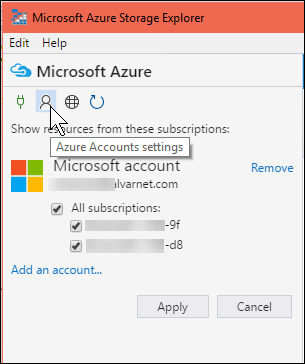
Launch Azure Storage Explorer and click the plug-in icon on the left.
Select Add an Azure Account, and then click Next.
In the Azure Sign in dialog box, enter your Azure credentials.
Select your subscription from the list and then click Apply.
Upload a managed disk from an on-prem VHD
On the left pane, expand Disks and select the resource group that you want to upload your disk to.
Select Upload.
In Upload VHD specify your source VHD, the name of the disk, the OS type, the region you want to upload the disk to, as well as the account type. In some regions Availability zones are supported, for those regions you can select a zone of your choice.
Select Create to begin uploading your disk.
The status of the upload will now display in Activities.
If the upload has finished and you don't see the disk in the right pane, select Refresh.
Download a managed disk
The following steps explain how to download a managed disk to an on-prem VHD. A disk's state must be Unattached in order to be downloaded, you cannot download an Attached disk.
Ms Azure Storage Explorer 2019
On the left pane, if it isn't already expanded, expand Disks and select the resource group that you want to download your disk from.
On the right pane, select the disk you want to download.
Select Download and then choose where you would like to save the disk.
Select Save and your disk will begin downloading. The status of the download will display in Activities.
Copy a managed disk
With Storage Explorer, you can copy a manged disk within or across regions. To copy a disk:
From the Disks dropdown on the left, select the resource group that contains the disk you want to copy.
On the right pane, select the disk you'd like to copy and select Copy.
On the left pane, select the resource group you'd like to paste the disk in.
Select Paste on the right pane.
In the Paste Disk dialog, fill in the values. You can also specify an Availability zone in supported regions.
Select Paste and your disk will begin copying, the status is displayed in Activities.
Create a snapshot
From the Disks dropdown on the left, select the resource group that contains the disk you want to snapshot.
On the right, select the disk you'd like to snapshot and select Create Snapshot.
In Create Snapshot, specify the name of the snapshot as well as the resource group you want to create it in. Then select Create.
Once the snapshot has been created, you can select Open in Portal in Activities to view the snapshot in the Azure portal.
Next steps
Learn how to Create a VM from a VHD by using the Azure portal.
Ms Azure Storage Explorer Download
Learn how to Attach a managed data disk to a Windows VM by using the Azure portal.
-->Microsoft Azure Storage Explorer has a set of command-line options that can be added when starting the application. Most of the command-line options are for debugging or troubleshooting purposes.
Command-line options
| Option | Description |
|---|---|
--debug/--prod | Start the application in debug or production mode. In debug mode, the local attachment data will be stored in the application's local storage and it won't be encrypted. Hidden properties will be displayed in the Properties panel for selected resource nodes. Log verbosity level will be set to print debug messages revealing Storage Explorer's internal setup logic. The default value is --prod. |
--lang | Start the application with a given language. For example, --lang='zh-Hans'. |
--disable-gpu | Start the application without GPU acceleration. |
--auto-open-dev-tools | Let the application open the developer tools window as soon as the browser window shows. This option is useful when you want to hit a break point at a line in the start-up code of the browser window. |
--verbosity | Set the verbosity level of Storage Explorer logging. Supported verbosity levels include debug, verbose, info, warn, error, and silent. For example, --verbosity=verbose. When running in production mode, the default verbosity level is info. When running in debug mode, the log verbosity level will always be debug. |
--log-dir | Set the directory to save log files. For example, --log-dir=path_to_a_directory. |
An example of starting Storage Explorer with custom command-line options
Note
These command line options may change in new Storage Explorer versions.
When to use command-line options
Windows server 2012 r2 datacenter kms activation crack. Some command-line options can be used to customize Storage Explorer. For those options that have corresponding user settings, such as --lang. We recommend using the user settings instead of using the command-line option.
The other command-line options can be useful for debugging and troubleshooting. If you run into a problem in Storage Explorer, reproducing the problem in debug mode can help us get more detailed information to investigate.