
- Introduction
- User interface
- Get started
- Develop Persona (Raw)
- Sizing, cropping and warping
- Layers
- Layer operations
- Selections
- Creating pixel selections
- Retouching
- Adjustments
- Filters and effects
- Placing external content
- Panorama Persona
- HDR
- Stacking
- Astrophotography Stack Persona
- Focus merging
- Live projection
- Macros & batch jobs
- Liquify Persona
- Painting and erasing
- Layer effects (FX)
- Color
- Vector-specific
- Lines and shapes
- Text
- Text styles
- Sharing
- Export Persona
- Design aids
- Workspace
- Customize
- Tools
- Photo editing tools
- Vector line tools
- Selection tools
- Fill tools
- Paint tools
- Erase tools
- Retouch tools
- Vector shape tools
- Text tools
- Warp tools
- Liquify tools (Liquify Persona)
- Raw tools (Develop Persona)
- Export tools (Export Persona)
- Panels
- Appendix
- Extras
- Performance
- Third-party support
- Faster, smoother and more powerful than ever, Affinity Photo continues to push the boundaries of professional photo editing software. With a huge toolset specifically engineered for creative and photography professionals, it has everything you need to edit and retouch images, create full-blown, multi-layered compositions or beautiful raster paintings, and so much more.
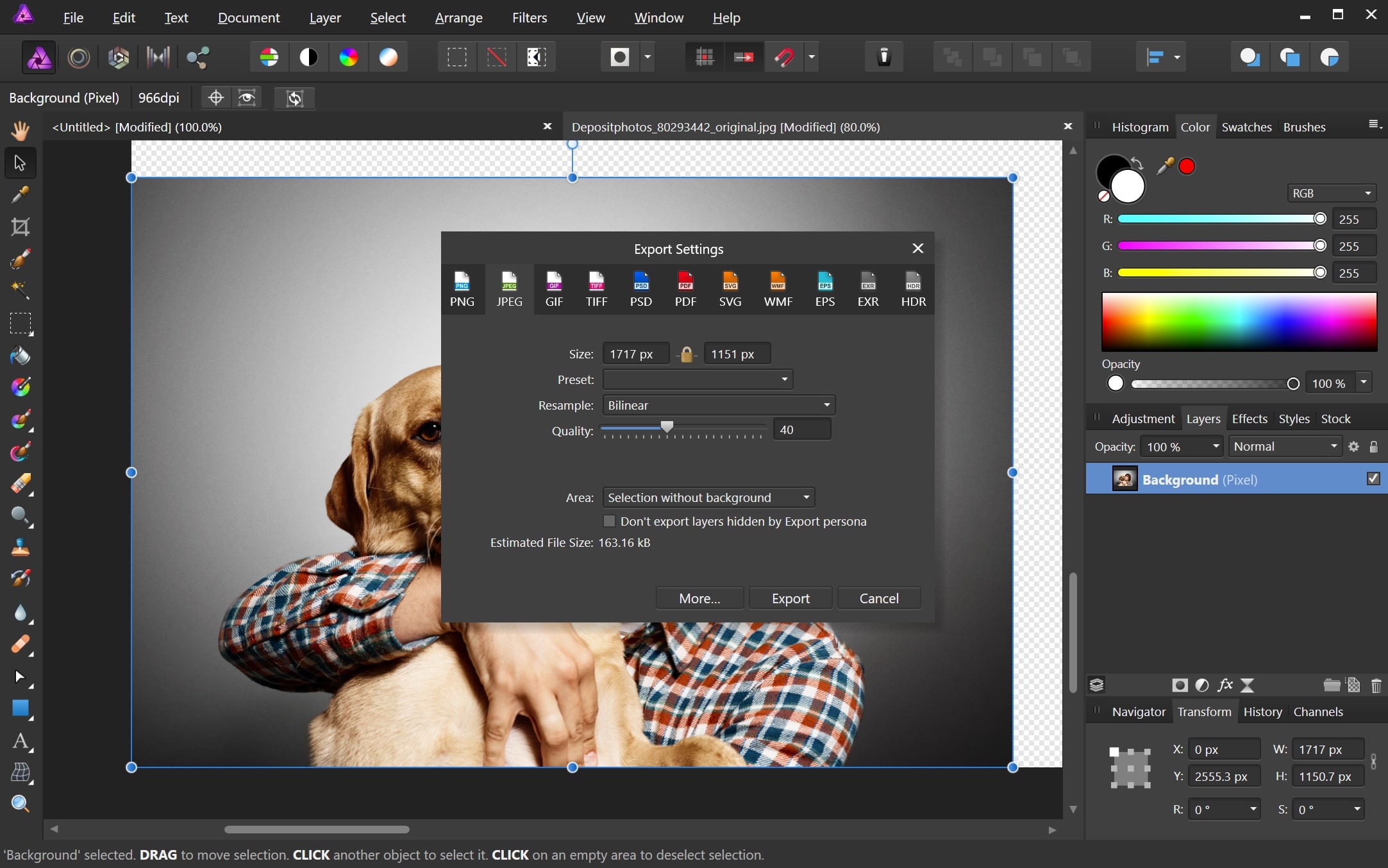
- Changing image size. To scale an image: From the Document menu, select Resize Document. Ensure the Resample option is switched off. Change the DPI to control the number of pixels (dots) which will be printed per inch when your document is printed. Set higher values (e.g., 300dpi) for professional printing.
Affinity Photo 1.9 is here, and as usual, it is free to existing users on the platform(s) a licence has been purchased for.
If you’re an Affinity Photo user who needs some help updating to 1.9, we recommend you check out this handy guide—How to install Affinity updates.
Photo: NFL via Getty Images Quick Facts Name Drew Brees Birth Date January 15, 1979 (age 42) Did You Know? Drew Brees comes from an athletic background, with a grandfather who was a well-known.
Let’s take a look at what’s new in this latest release.
1. Linked layers
In 1.9, you now have the ability to duplicate linked layers, then unlink particular attributes, which is really beneficial for composite work. If you want to take it further, you can also link specific attributes of completely different layers, then manage everything on the intuitive Links panel.
James shows us some use cases for linked layers in this video.
2. Astrophotography stacking
One for the stargazers out there—in Photo 1.9 you are now able to stack deep sky astrophotography imagery, including FITs documents in addition to RAW files. This makes Affinity Photo one of the very few cross-platform apps that can perform the entire astrophotography post-production workflow, from stacking to powerful editing and retouching—all in 32-bit precision.
For stacking, you can auto-detect hot/cold pixels and manually highlight column defects to produce a cleaner stacked result. There’s also a dedicated background removal filter—fantastic for removing difficult background gradients (light pollution, airglow, moon illumination, sensor defects) after tone stretching.
Check out the tutorial below, plus five other in-depth Astrophotography videos on our website.
3. Hardware acceleration on Windows
Hardware acceleration uses your computer’s GPU devices to dramatically increase rendering performance for raster-based operations, such as compositing pixel layers, adjustment layers, live filters and raster tools. Mac users have enjoyed the benefits of Metal Compute hardware acceleration since version 1.7 and now Windows users can enjoy this same benefit and experience some massive performance gains, especially with more esoteric workflows like complex layer compositing in 16-bit or 32-bit pixel formats.
Here James explains how to enable and disable this feature on both platforms and how it can be beneficial.
4. Pattern layers
Create endlessly-repeating patterns just by simply painting into the bounds of this new layer format, then rotate, shear, scale, clip and mask it for some fantastic design ideas. What’s more, you can also create pattern layers from existing raster layers, giving you another approach to bitmap pattern fills for architecture and other design workflows.
In this video, James shows us how to add seamless raster textures and patterns to diagrams and illustrations using this new feature.
5. Studio presets
In Photo 1.9 you can create, save and recall different interface layouts with ease. You’ll find this incredibly useful if you have multiple users that prefer different layouts, or if you have specific workflow setups that you wish to toggle between—you might have dedicated layouts for colour grading, retouching, brushwork, vector design and compositing, just to name a few disciplines.
James runs through how to customise your workspace, save studio presets and quickly switch between them in this video.
And there’s more…
There are so many cool features packed into Affinity Photo 1.9, we found it hard to pick just five. Here are some other exciting new additions we really want to tell you about.
Live Liquify
A much-requested feature—in Photo 1.9 you have the ability to perform Liquify operations non-destructively using a live filter layer, rather than committing your changes to a pixel layer.
LUT improvements
You can now batch-import LUTs (lookup tables) to the Adjustment panel and quickly audition them on your document.
External file linking
Placed images and documents can now be linked externally. You will also find a dedicated Resource Manager dialog to manage these external files.
In this video, James explains how to enable linked resources, allowing you to place images and documents into your work that can be updated externally.
Custom brushes from layer selections
Image and intensity brushes can quickly and easily be created from pixel and mask layers—a fantastic way of speeding up brush creation workflows.
This feature opens up a variety of creative possibilities, some of which you can see in this video.
Divide blend mode
In an image editing workflow, this new blend mode helps you to correct difficult colour casts and opens up further tonal options when used with live filter layers.
James runs through some corrective and creative uses for the Divide blend mode in this tutorial.
Check out our 1.9 Affinity creative sessions
For even more information about this latest release, check out the 1.9 Affinity creative sessions led by our in-house product experts. They run through all the major updates to each app, and you can stream them at any time on our official YouTube channel.
Watch more tutorials
Affinity Photo Trial
We have a fantastic range of video tutorials designed to help you get the most out of Affinity Photo 1.9 on our website.
Affinity Photo Scale
Find out more about our 1.9 updates:
Affinity Photo is currently 50% off
In response to the continued impact of the COVID-19 pandemic, we have once again cut the price of our apps by 50%—including the newly released 1.9 versions, so if you don’t have Affinity Photo yet, now is a great time to purchase a copy.
Affinity Photo Scale Layer
Affinity Photo Scale Canvas
The 90-day free trial of the Mac and Windows versions of the whole Affinity suite is also back for a limited time. For more details and to download the free trial, go to the Affinity website.
Existing users can download v1.9 free from their Affinity account.